
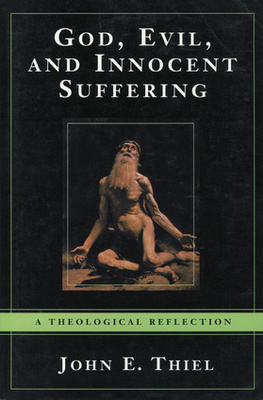
This collection features books and book contributions written by faculty in the Department of Religious Studies at Fairfield University.
















-
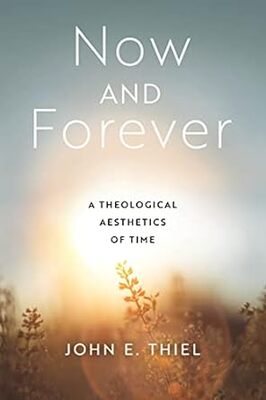
Now and Forever: A Theological Aesthetics of Time
John E. Thiel
Building on the insights of the ressourcement theology of grace, this sophisticated theological aesthetics offers a fresh vision of the doctrine of creation through a consideration of the beauty of time.
Conventional eschatological accounts of life after death tend to emphasize the discontinuity between earthly life and the hereafter: whereas this life is subject to the contingencies of time, life after death is characterized by a stolid eternity. In contrast to this standard view, John E. Thiel’s Now and Forever articulates a Catholic eschatology in which earthly life and heavenly life are seen as gracefully continuous.
This account offers a reconceptualization of time, which, Thiel argues, is best understood as the sacramental medium of God’s grace to creation. Thiel’s project thus attempts to rescue time from its Platonically negative resonance in the doctrine of creation. Rather than viewing time as the ambiance of sinful dissolution, Thiel argues for a Christian vision of time’s beauty, and so explicitly develops an aesthetics that views time as a creaturely reflection of God’s own Trinitarian life. This thesis proceeds from the assumption that all time is eschatological time and is thus guided by attention to the temporality implicit in the virtue of hope, with its orientation toward a fulfilled future that culminates in resurrected life. This interpretation of the beauty of eschatological time in its widest expanse presses further the insight of ressourcement theology that grace is everywhere, while appreciating how time’s graceful beauty manifests itself in the diversity of temporal moments, human communities, and most fully in the heavenly communion of the saints.
-
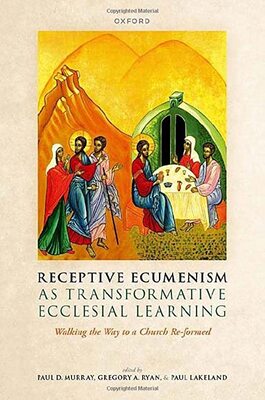
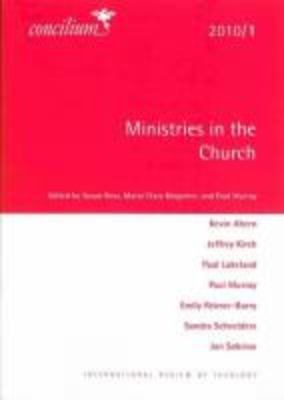
Receptive Ecumenism as Transformative Ecclesial Learning: Walking the Way to a Church Re-formed
Paul D. Murray, Gregory A. Ryan, and Paul F. Lakeland
Paul Lakeland is an editor and contributing author, "What Does Rome Have to Learn from Geneva? Whole- Body Ecclesiology and the Inductive Turn," Chapter 11, pp. 124-130.
Receptive Ecumenism asks not what other churches can learn from us, but ‘what can we learn and receive with integrity from our ecclesial others?’. This demands more than viewing gifts from another tradition as objects of reception. Receiving with integrity also involves a transformation of the church as subject in the act of reception. It represents the church in a mode of ‘ecclesial learning’. Since the publication of Receptive Ecumenism and the Call to Catholic Learning: Exploring a Way for Contemporary Ecumenism (2008), this fresh ecumenical strategy has been adopted, critiqued, and developed in different Christian traditions, and in local, national, and international settings, including the most recent bilateral dialogue of the Anglican-Roman Catholic International Commission (ARCIC III). This volume shows how Receptive Ecumenism is being received ‘with dynamic integrity’ in Christian communities representing different ecclesial traditions and geographies. The potential for such ecumenical ecclesial learning is illustrated in respect of recurrent ecclesial problems, such as the understanding and practice of ministry. Throughout the book, and particularly in the final part, the contributors draw on Scripture, hermeneutics, and pneumatology to offer a critical reflection on how Receptive Ecumenism itself implements ecclesial learning. These thirty-eight essays by academics, church leaders, and ecumenical practitioners show how Receptive Ecumenism has matured since its launch not only in terms of ecclesial application and geographical breadth, but also in critical depth.
-
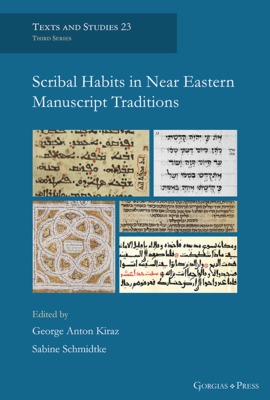
Scribal Habits in Near Eastern Manuscript Traditions
George Anton Kiraz, Sabine Schmidtke, and Thomas C. Schmidt
Thomas C. Schmidt is a contributing author, "Scribes and the Book of Revelation in Eastern New Testaments."
Most scholars who employ manuscripts in their research tend to focus on the literary content itself. But what about the role of the scribe who typically remains at the periphery of research? How can we, in the words of the NT textual critic James Royse, “virtually look over the scribe’s shoulder” to understand the process by which our manuscripts were produced? Moreover, manuscripts often contain far more material than the words that form their primary texts: dots and various other symbols that mark vowels (in the case of Semitic languages), intonation, readings aids, and other textual markers; marginal notes and sigla that provide additional explanatory content akin to but substantially different from our modern notes and endnotes; images and illustrations that present additional material not found in the main text. These extratextual (or peritextual) elements add additional layers to the main body of the text and are crucial for our understanding of the text’s transmission history as well as scribal habits. This volume brings together contributions by scholars focusing on such extra-, peritextual elements as found in Middle Eastern manuscripts written in Hebrew, Syriac, Arabic, Persian and other languages, to study the individuals who produced our manuscripts and how they shaped the transmission of literary texts they copied.
-
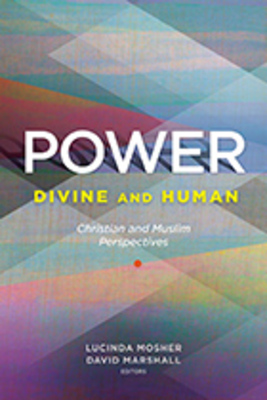
Power: Divine and Human - Christian and Muslim Perspectives
Lucinda Mosher, David Marshall, and Martin Nguyen
Martin Nguyen is a contributing author, "The Contours of God's Power: An Introduction to Passages from the Qur'an and Hadith," pp.31-41.
This volume of the Building Bridges Seminar, Power: Divine and Human, Christian and Muslim Perspectives, comprises pairs of essays by Christians and Muslims which introduce texts for dialogical study, plus the actual text-excerpts themselves.
This new book goes far beyond mere reporting on a dialogical seminar; rather, it provides guidance and materials for constructing a similar dialogical experience on a particular topic. As a resource for comparative theology, Power: Divine and Human is unique in that it takes up a topic not usually explored in depth in Christian-Muslim conversations. It is written by scholars for scholars. However, in tone and structure, it is suitable for the non-specialist as well. Students (undergraduate and graduate), religious leaders, and motivated non-specialists will find it readable and useful. While it falls solidly in the domain of comparative theology, it can also be used in courses on dialogical reading of scripture, interreligious relations, and political philosophy.
-
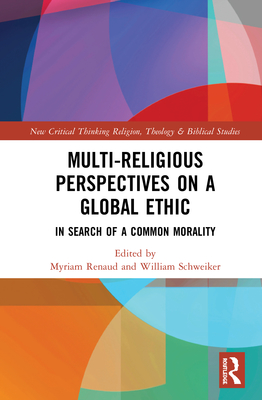
Multi-Religious Perspectives on a Global Ethic: In Search of a Common Morality
Myriam Reynaud, William Schweiker, and Martin Nguyen
Martin Nguyen is a contributing author, "Sunni Islam and the Estranged Ideal: The Displaced, the Racially Disenfranchised, and the Islamic Prophetic," Chapter 7, pgs 137-148.
Ratified by the Parliament of the World’s Religions in 1993 and expanded in 2018, "Towards a Global Ethic (An Initial Declaration)," or the Global Ethic, expresses the minimal set of principles shared by people—religious or not. Though it is a secular document, the Global Ethic emerged after months of collaborative, interreligious dialogue dedicated to identifying a common ethical framework. This volume tests and contests the claim that the Global Ethic’s ethical directives can be found in the world’s religious, spiritual, and cultural traditions.
The book features essays by scholars of religion who grapple with the practical implications of the Global Ethic’s directives when applied to issues like women’s rights, displaced peoples, income and wealth inequality, India’s caste system, and more. The scholars explore their respective religious traditions’ ethical response to one or more of these issues and compares them to the ethical response elaborated by the Global Ethic. The traditions included are Hinduism, Engaged Buddhism, Shi‘i Islam, Sunni Islam, Confucianism, Protestantism, Catholicism, Judaism, Indigenous African Religions, and Human Rights. To highlight the complexities within traditions, most essays are followed by a brief response by an expert in the same tradition.
Multi-Religious Perspectives on a Global Ethic is of special interest to advanced students and scholars whose work focuses on the religious traditions listed above, on comparative religion, religious ethics, comparative ethics, and common morality.
-
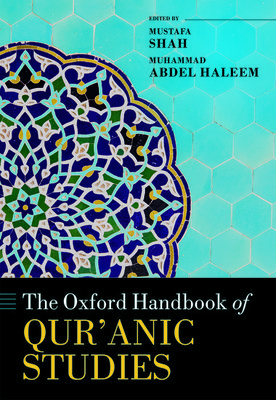
The Oxford Handbook of Qur'anic Studies
Mustafa Shah, M.A.S. Abdel Haleem, and Martin Nguyen
Martin Nguyen is a contributing author,"Sunni Hermeneutical Literature," Chapter 56, pgs 832-847.
The Qur'an is the foundational sacred text of the Islamic faith. Traditionally revered as the literal word of God, its pronouncements and discussions form the bedrock of Islamic beliefs and teachings. Notwithstanding its religious pre-eminence and the fact that it is the sacred text for over one billion of the world's Muslims, the Qur'an is also considered to be the matchless masterpiece of the Arabic language. Its historical impact as a text can be discerned in all aspects of the heritage of the Arabic literary tradition. Over recent decades, academic engagement with the Qur'an has produced an impressive array of scholarship, ranging from detailed studies of the text's unique language, style and structure, to meticulous surveys of its contents, concepts and historical contexts. The Oxford Handbook of Qur'anic Studies is an essential reference and starting point for those with an academic interest in the Qur'an. It offers not only detailed reviews of influential subjects in the field, but also a critical overview of developments in the research discourse. It explores the tradition of Qur'anic exegesis and hermeneutics, making it a comprehensive academic resource for the study of the Qur'an. No single volume devoted to such a broad academic survey of the state of the field currently exists.
-
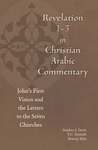
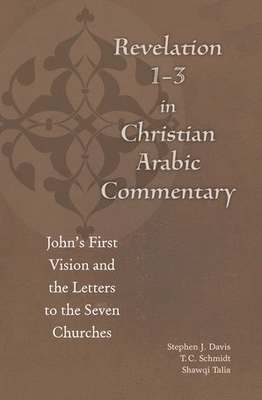
Revelation 1-3 in Christian Arabic Commentary: John's First Vision and the Letters to the Seven Churches
Stephen J. Davis, Thomas C. Schmidt, and Shawqi Talia
The first publication in a new series—Christian Arabic Texts in Translation, edited by Stephen Davis—this book presents English-language excerpts from thirteenth-century commentaries on the Apocalypse of John by two Egyptian authors, Būlus al-Būshī and Ibn Kātib Qas.ar. Accompanied by scholarly introductions and critical annotations, this edition will provide a valuable entry-point to important but understudied theological work taking place at the at the meeting-points of the medieval Christian and Muslim worlds.
-
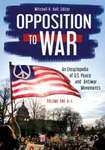
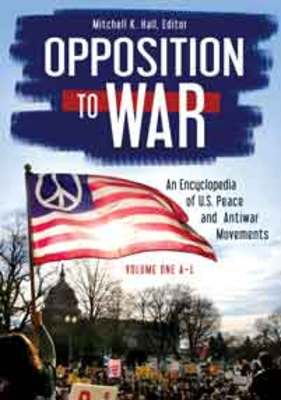
Opposition to War: An Encyclopedia of United States Peace and Antiwar Movements
Mitchell K. Hall and Lydia Willsky-Ciollo
Lydia Willsky-Ciollo is a contributing author, “Henry David Thoreau” and “Transcendentalism.”
Book description:
How have Americans sought peaceful, rather than destructive, solutions to domestic and world conflict? This two-volume set documents peace and antiwar movements in the United States from the colonial era to the present. Although national leaders often claim to be fighting to achieve peace, the real peace seekers struggle against enormous resistance to their message and have often faced persecution for their efforts. Despite a well-established pattern of being involved in wars, the United States also has a long tradition of citizens who made extensive efforts to build and maintain peaceful societies and prevent the destructive human and material costs of war. Unarmed activists have most consistently upheld American values at home. Opposition to War: An Encyclopedia of U.S. Peace and Antiwar Movements investigates this historical tradition of resistance to involvement in armed conflict—an especially important and relevant topic today as the nation has been mired in numerous military conflicts throughout most of the current century. The book examines a largely misunderstood and underappreciated minority of Americans who have committed themselves to finding peaceful resolutions to domestic and international conflicts—individuals who have proposed and conducted an array of practical and creative methods for peaceful change, from the transformation of individual behavior to the development of international governing and legal systems, for more than 250 years. Readers will learn how individuals working alone or organized into societies of various size have steadfastly campaigned to stop war, end the arms race, eliminate the underlying causes of war, and defend the civil liberties of Americans when wartime nationalism most threatens them.
-
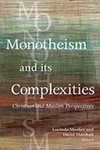
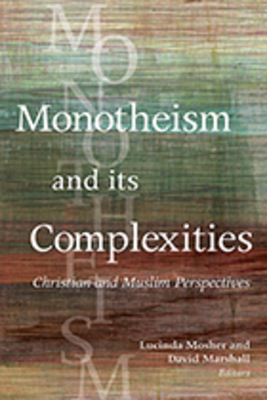
Monotheism and Its Complexities: Christian and Muslim Perspectives
Lucinda Mosher, David Marshall, and Martin Nguyen
Martin Nguyen is a contributing author, “Of Storytellers and Storytelling: A Muslim Response to Christoph Schwöbel," p.93-93.
Book description:
Conventional wisdom would have it that believing in one God is straightforward; that Muslims are expert at monotheism, but that Christians complicate it, weaken it, or perhaps even abandon it altogether by speaking of the Trinity. In this book, Muslim and Christian scholars challenge that opinion. Examining together scripture texts and theological reflections from both traditions, they show that the oneness of God is taken as axiomatic in both, and also that affirming God's unity has raised complex theological questions for both. The two faiths are not identical, but what divides them is not the number of gods they believe in. The latest volume of proceedings of The Building Bridges Seminar—a gathering of scholar-practitioners of Islam and Christianity that meets annually for the purpose of deep study of scripture and other texts carefully selected for their pertinence to the year's chosen theme—this book begins with a retrospective on the seminar's first fifteen years and concludes with an account of deliberations and discussions among participants, thereby providing insight into the model of vigorous and respectful dialogue that characterizes this initiative.
-
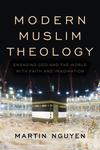
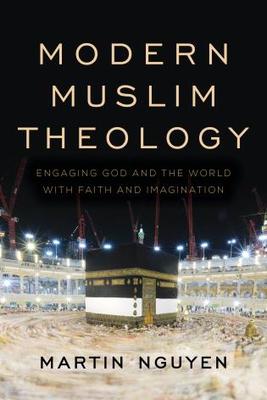
Modern Muslim Theology: Engaging God and the World with Faith and Imagination
Martin Nguyen
This book aims to bring Muslim theology into the present day. Rather than a purely academic pursuit, Modern Muslim Theology argues that theology is a creative process and discusses how the Islamic tradition can help contemporary practitioners negotiate their relationships with God, with one another, and with the rest of creation.
-
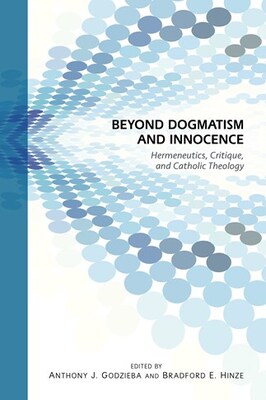
Beyond Dogmatism and Innocence: Hermeneutics, Critique, and Catholic Theology
Anthony J. Godzieba, Bradford E. Hinze, and John E. Thiel
John E. Thiel is a contributing author, "The Aesthetics of Tradition and Styles of Theology," Chapter 4, pp. 56-83
Behind every important development in Catholic doctrine and practice since the beginning of the modern period have been debates about the interpretation of Christianity's classic texts and traditions and their ideological and practical implications.
Over the past century there have been breakthroughs in retrieving the origins of beliefs and practices, recovering the rich, myriad, and multifaceted literary forms, and recognizing the ways these venerable traditions have been received, applied, and negotiated in the lives of reading audiences with their contrasting worldviews.
The essays in this volume by leading figures in Catholic theology suggest what might be called a "third naïveté" that blends deeply contextual interpretations with a critical theological analysis of the roles of power and grace in church and society.
The abilities and skills to grapple with basic issues in hermeneutics and critical theory remain necessary and fundamental for Catholic theology. At stake is nothing less than how the good news of God's salvation can be grasped and lived today. This volume provides a trustworthy map and compass for negotiating these debates and options.
Contributors include: Sandra M. Schneiders, Francis Schüssler Fiorenza, Robert J. Schreiter, John E. Thiel, Dominic Doyle, Fernando F. Segovia, Andrew Prevot, Ormond Rush, Judith Gruber, Susan Abraham, Anthony J. Godzieba, and Bradford E. Hinze.
-
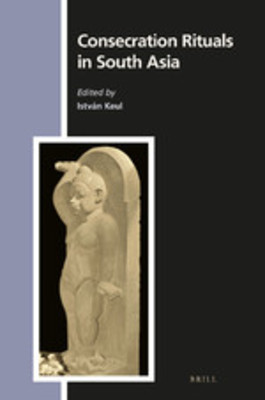
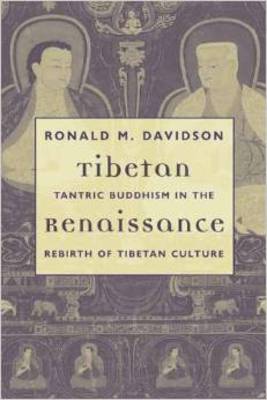
Consecration Rituals in South Asia
István Keul and Ronald M. Davidson
Ronald M. Davidson is a contributing author, "“Studies in Dhāraṇī Literature IV: A Nāga Altar in 5th Century India”, pp. 123-170.
Book description: The essays in the volume Consecration Rituals in South Asia address the ritual procedures that accompany the installation of temple images in Shaiva, Vaishnava, Buddhist and Jain contexts, in various traditions and historical periods. Through the performance of complex rites designated with the term pranapratishtha (establishment of, or infusion with, life), man-made sculptures are ritually transformed into (receptacles of) deities. The collection is thematically and methodically broad, with a large number of detailed textual studies, but also with ethnographic contributions that discuss contemporary instances of consecration rituals. Among the overarching themes are issues related to historical continuity and change, as well as transformational moments in such rituals.
-
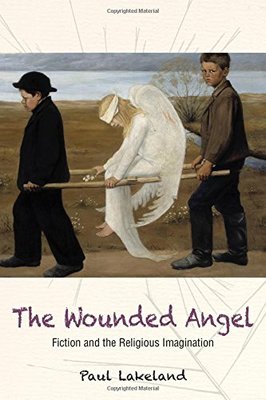
The Wounded Angel: Fiction and the Religious Imagination
Paul F. Lakeland
In this unique book, readers are taken on a journey to explore the role of the imagination in the face of mystery, whether it be the mystery of God, whose full reality lies beyond our earthly horizons, or the deepest mysteries of life hinted at in the work of fiction. By attending to a series of novels, Paul Lakeland proposes serious fiction as an antidote to the failure of the religious imagination today and shows how literature might lead the secular mind at least to the threshold of mystery. -- Publisher's description.
-
Hippolytus of Rome: Commentary on Daniel and 'Chronicon'
Thomas C. Schmidt and Nick Nicholas
This volume contains the earliest Christian works of commentary and history that are extant: Hippolytus of Rome’s Commentary on Daniel and his Chronicon. Both were written likely between 202–235 CE and are here translated into English for the first time by Thomas C. Schmidt, with Nick Nicholas serving as co-translator for the Chronicon.
In his Commentary on Daniel Hippolytus interprets the deeds and visions of Daniel against the backdrop of contemporary Roman persecution and eschatological expectations, thus providing much information about Christian affairs in the early third century. Throughout the commentary Hippolytus discusses his distinctive Logos theology and also mentions various liturgical practices involving baptism, anointing and the celebration of Easter. In his Chronicon, Hippolytus tallies the years of the world from creation to his present day while also devoting much time to ethnography and geography, and so draws for us a detailed landscape of the world as viewed from a Roman Christian mind. In the Chronicon and the Commentary on Daniel, Hippolytus also makes reference to the birth of Christ, which he may have placed on December 25.
Schmidt introduces both works by discussing the person of Hippolytus and explaining the complicated and contradictory theories regarding the authorship of the ‘Hippolytan Corpus.’ He argues that the principal works in the corpus likely stem from the same early third century Roman Christian community and that Hippolytus of Rome authored the Commentary on Daniel and authored or at least edited the Chronicon.
-

The World Religions & Spirituality Project
David G. Bromley and Lydia Willsky-Ciollo
Lydia Willsky-Ciollo is a contributing author, "Frances Willard."
Project description:
The World Religions & Spirituality Project (WRSP) was established in 2010 at Virginia Commonwealth University. The mission of the WRSP is to provide objective, reliable and comprehensive information about the world’s diverse array of religious and spiritual groups. The central feature of the WRSP website is, therefore, profiles of contemporary religious and spiritual movements, established world religions, and historical religious and spiritual movements. Wherever possible, profiles are prepared by scholars of record for the groups that they profile. Each profile includes a presentation of the group’s history, distinctive beliefs, rituals, organization and leadership, and issues/challenges. Particularly with respect to newer groups, reliable information often is less accessible, and this website offers comprehensive, balanced information for religion scholars, students, media representatives and those with a personal interest in understanding the diversity of religious and spiritual alternatives in the contemporary world. In addition to the group profiles, WRSP features an ARTICLES/PAPERS section, which contains scholarship that supplements and provides context for the profiles; an ARCHIVES section, which hosts historically important documents for some groups and provides links to other archival sites; the WRSP FORUM, which conducts interviews with individuals who offer important information and perspective on groups and issues relevant to the WRSP mission; WRSP VIDEO CONNECTIONS, which provides links to contextual video material that can be found online; and WRSP SPECIAL PROJECTS, which provide all of the WRSP components for specific topics or geographical regions. The World Religions and Spirituality Project draws its original inspiration and impetus from the New Religious Movements Homepage Project, which was founded in 1995 by Professor Jeffrey K. Hadden in conjunction with an undergraduate course on New Religious Movements. Under Professor Hadden’s leadership the Religious Movements Homepage grew into one of the largest sites of its kind in the world and became an important Internet resource for scholarship and teaching in the area of contemporary religious movements. Following Professor Hadden’s untimely death in 2003, Professor Douglas E. Cowan, Renison College of the University of Waterloo, assumed the position of Project Director to assure the website’s continuation. In 2010, Professor David G. Bromley, Virginia Commonwealth University, became Project Director and redirected and broadened the mission of what has now become the World Religions & Spirituality Project (WRSP). New components have been added to the original project, and authors now are recruited from scholars around the world who are authors of record on the groups they profile, and groups of scholars are assuming leadership roles in WRSP through the development or WRSP SPECIAL PROJECTS.
-
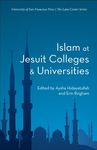
Lane Center Series Volume 4: Islam at Jesuit Colleges & Universities
Aysha Hidayatullah, Erin Brigham, and Martin Nguyen
Martin Nguyen is a contributing author, "Issues of Immediacy and Identity in Scholarship and Pedagogy for Islam in the Academy," 43-52.
Book description: The Lane Center is pleased to offer The Lane Center Series Volume 4: Islam at Jesuit Colleges and Universities, a published volume of conference remarks.
-
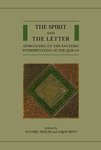
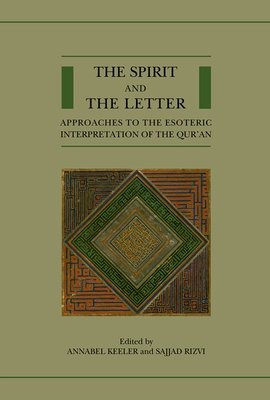
The Spirit and the Letter Approaches to the Esoteric Interpretation of the Qur'an
Annabel Keeler, Sajjad H. Rizvi, and Martin Nguyen
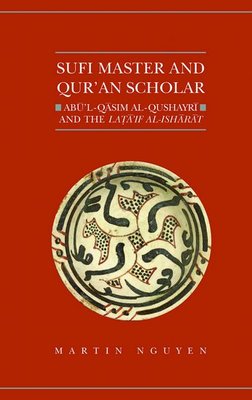
Martin Nguyen is a contributing author, "Qushayri's Exegetical Encounter with the Mi'raj."
Book description: This volume is the first to focus specifically on esoteric interpretation as a phenomenon in the field of Qur'anic exegesis and to show the plurality of ways it has been manifested in different Muslim traditions. Concern with the inner, spiritual implications of the Qur'an has usually been associated with mystical and Sufi trends in Islam. However, there have also been exegetes among the Shi'a, as well as among philosophers, who sought to supplement their understanding of the Qur'an's apparent meaning by eliciting deeper significations through contemplation of the verses. The Spirit and the Letter examines the multiplicity of these esoteric approaches, covering a period that extends from the third/ninth century to the present. It includes chapters on philosophical and Shi'i exegetes, such as Ibn Sina (d. 428/1037) and Mulla Sadra (d. 1045/1635-6), in addition to studies of a range of Sufi perspectives, from al-Sulami (d. 412/1021) and al-Qushayri (d. 465/1072) to Ruzbihan Baqli (d. 606/1209), as well as representatives of the Ibn 'Arabi and Kubrawi schools. Considered together, the range of studies in this volume enable us to see what these approaches have in common and how they differ, and how the hermeneutics and content of exegesis are affected by doctrinal and ideological perspectives of various traditions and periods. Furthermore, they deepen our understanding of what actually constitutes esoteric interpretation and the need to look beyond the letter to the spirit of the Qur'anic word.
-
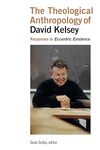
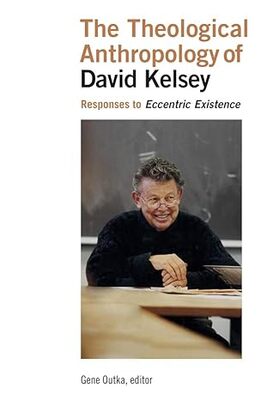
The Theological Anthropology of David Kelsey: Responses to Eccentric Existence
Gene Outka and John E. Thiel
John E. Thiel is a contributing author, "Methodological Choices in Kelsey's Eccentric Existence," pp. 1-15.
David Kelsey's two-volume masterwork, Eccentric Existence: A Theological Anthropology, has been recognized as a major achievement, the culmination of decades of probing theological thought about what it means to be a human being in relationship with God.
Ten distinguished scholars respond to and interact with Eccentric Existence in this book, celebrating both Kelsey and his landmark study with essays on theological anthropology as it relates to the Bible, Catholic tradition, theological education, and other subjects.
-
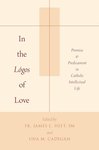
In the Lógos of Love:Promise and Predicament in Catholic Intellectual Life
James L. Heft, Una M. Cadegan, and Nancy Dallavalle
Nancy Dallavalle is a contributing author, "Sex and Gender and Sexuality: Competing Claims? A Catholic Response”.
BOOK DESCRIPTION: So much has changed about Catholic intellectual life in the half century since the end of the Second Vatican Council that it has become difficult to locate the core concepts that make up the tradition. In the Lógos of Love is a collection of essays that grew out of a 2013 conference on Catholic intellectual life co-sponsored by the University of Dayton and the Institute for Advanced Catholic Studies at the University of Southern California. The essays, written by scholars of theology, history, law, and media studies of religion, trace the history of this intellectual tradition in order to craft new tools for understanding the present day and approaching the future. Each essay explores both the promise of Catholic intellectual life and its various contemporary predicaments. How does a changed media landscape affect the way Catholicism is depicted, and the way its adherents understand and communicate among themselves? What resources can the tradition offer for reflection on new understandings of sexuality and gender? How can and should US Catholic intellectual life embrace and enhance-and introduce students to-the new ways in which Catholicism is becoming a more global tradition? What is the role of scholars in disciplines beyond theology? Of scholars who are not Catholic? Of scholars in universities not sponsored by Catholic religious orders or dioceses? By providing context for and proposing responses to these questions, the scholars invite discussion and reflection from a wide range of readers who have one important thing in common-a stake in sustaining a vibrant, flourishing intellectual tradition.
-
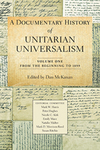
A Documentary History of Unitarian Universalism, Volume 1
Dan McKanan and Lydia Willsky-Ciollo
Lydia Willsky-Ciollo is a contributing author, "Introduction to Andrews Norton's 'Discourse on the Latest Form of Infidelity'," p.280.
Book description:
A panel of top scholars presents the first comprehensive collection of primary sources from Unitarian Universalist history. This, the first of the two-volume set, covers the early histories of Unitarianism and Universalism, from the third century up to 1899. From Arius and Origen to Theodore Parker and Olympia Brown, this rich anthology features leaders, thinkers, and ordinary participants in the ever-changing tradition of liberal religion. This volume contains more than a hundred distinct documents, with scholarly introductions by leading experts in Unitarian Universalist history. The selections include sermons, theologies, denominational statements, hymns, autobiographies, and manifestos, with special attention to class, cultural, gender, and sexual diversity. Primary sources are the building blocks of history, and A Documentary History of Unitarian Universalism presents the sources we need for understanding this denomination's past and for shaping its future.
-
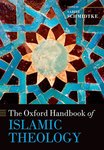
The Oxford Handbook of Islamic Theology
Sabine Shmidtke and Martin Nguyen
Martin Nguyen is a contributing author, "Sufi Theological Thought," 325.
Book description: Within the field of Islamic Studies, scientific research of Muslim theology is a comparatively young discipline. Much progress has been achieved over the past decades with respect both to discoveries of new materials and to scholarly approaches to the field. The Oxford Handbook of Islamic Theology provides a comprehensive and authoritative survey of the current state of the field. It provides a variegated picture of the state of the art and at the same time suggests new directions for future research. Part One covers the various strands of Islamic theology during the formative and early middle periods, rational as well as scripturalist. To demonstrate the continuous interaction among the various theological strands and its repercussions (during the formative and early middle period and beyond), Part Two offers a number of case studies. These focus on specific theological issues that have developed through the dilemmatic and often polemical interactions between the different theological schools and thinkers. Part Three covers Islamic theology during the later middle and early modern periods. One of the characteristics of this period is the growing amalgamation of theology with philosophy (Peripatetic and Illuminationist) and mysticism. Part Four addresses the impact of political and social developments on theology through a number of case studies: the famous mihna instituted by al-Ma'mun (r. 189/813-218/833) as well as the mihna to which Ibn 'Aqil (d. 769/1367) was subjected; the religious policy of the Almohads; as well as the shifting interpretations throughout history (particularly during Mamluk and Ottoman times) of the relation between Ash'arism and Maturidism that were often motivated by political motives. Part Five considers Islamic theological thought from the end of the early modern and during the modern period.
-
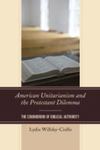
American Unitarianism and the Protestant dilemma : the conundrum of Biblical authority
Lydia Willsky-Ciollo
Book description: This work traces the greater narrative of biblical authority in Protestantism through the story of four main Unitarian figures: William Ellery Channing, Andrews Norton, Theodore Parker, and Frederic Henry Hedge. All four individuals played a central role, at different times, in shaping Unitarianism, and in determining how exactly religious authority functioned in their nascent denomination. Besides these central figures, the book goes both backward, examining the evolution of biblical authority from the late medieval period in Europe to the early nineteenth century in America, and forward, exploring the period of Unitarian experimentation of religious authority in the late nineteenth century. The book also brings the book firmly into the present, exploring how questions about the Bible and religious authority are being answered today by contemporary Unitarian Universalists. Overall, this book aims to bring the American Unitarians firmly back into the historical and historiographical conversation, not as outliers, but as religious people deeply committed to solving the Protestant dilemma of religious authority.
-
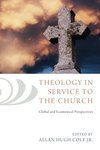
Theology in Service to the Church: Global and Ecumenical Perspectives
Allan Hugh Cole and Paul F. Lakeland
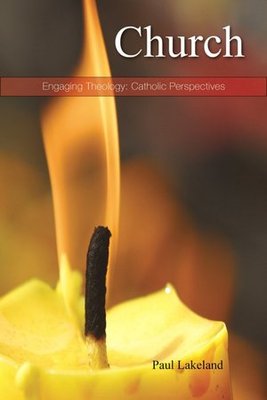
Paul Lakeland is a contributing author, "Knowing our Place(s): The Ecclesial Role(s) of the Theologian," pp. 59-71.
BOOK DESCRIPTION: As a global religion with growing numbers of expressions, Christianity calls for deepening relationships across traditions while also formulating collaborative visions. A thriving church will require Christians from various traditions and on varying trajectories to become familiar with one another, appreciate one another, and work in common service to God in Jesus Christ. In this book, a group of thirteen distinguished scholars from around the world and representing a range of Orthodox, Catholic, and Protestant perspectives demonstrate how theological reflection and broad-based ecumenical conversations may serve the church. Reflecting on numerous salient matters facing the global church, these scholars model what may be accomplished in ecumenical conversations that recognize the gifts that come with unity across diversity among those who seek to be faithful to Jesus Christ. -- Publisher description
-
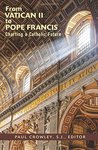
From Vatican II to Pope Francis: Charting a Catholic Future
Paul Crowley S.J. and Paul F. Lakeland
Paul Lakeland is a contributing author, "Set Into the Future: The Role of the Laity," pp. 127-140.
BOOK DESCRIPTION: Leading Catholic scholars explore the agneda of Vatican II and the future of the church. Fifty years after the Second Vatican Council, the Church is still grappling with the meaning and implications of this defining event and the documents it generated. Rather than rehearse well-worn debates over the interpretation of the Council, the contributors to this volume instead focus on where we go from here. What can we do now, with the inspiration of these teachings in a starkly different world? How do we chart a future for the Church from the standpoint of today? These questions are colored by the new atmosphere created by Pope Francis, who has resoundingly endorsed the Council's program for the Church and urged an openness to follow where the spirit leads. Topics include the principle of collegiality, the call to justice, the authority of conscience and religious liberty, interreligious dialogue, the role of women, the laity, and the future of ordained ministry. --Publisher's Description
-
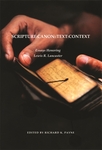
Scripture:Canon::Text:Context—Essays Honoring Lewis Lancaster
Ronald M. Davidson
Ronald M. Davidson is a contributing author, "“Studies in Dhāraṇī Literature III: Seeking the Parameters of a Dhāraṇī-piṭaka, the Formation of the Dhāraṇīsaṃgrahas, and the Place of the Seven Buddhas”, pp. 119-180.
Book description: Lewis Rosser Lancaster’s vision led to the establishment of the Group in Buddhist Studies at the University of California, Berkeley, in 1972. The Group continues today as one of the most important programs for the academic study of Buddhism. Lancaster’s dissertation on the Chinese translations of the 8,000 Line Perfection of Wisdom sutra informed the program with a strong philological emphasis, and a focus on the detailed understanding the historical development of a text and the comparative study of different versions. His scholarly projects have included the creation of The Korean Buddhist Canon: A Descriptive Catalogue, which continues to serve as an important tool for research into the Buddhist canon. This work also relates to the contributions he made to Buddhist studies by bringing greater scholarly attention to Korean Buddhism. Much of his recent efforts have been devoted to integrating the power of data search procedures into the study of the history of the canon. These efforts include a challenge to traditional views of texts as self-contained autonomous entities with a clear and identifiable history. Instead texts emerge as events, that is, as nodes in networks, ones that have complex interconnections with one another.